Mexico’s industrial real estate market continues to adapt to an international environment shaped by geopolitical tensions and changes in trade relations, particularly amid the renegotiation of the USMCA and evolving relations with the United States. In this context, companies have adopted a more cautious approach to long-term investment and expansion decisions, while developers have become more selective in pursuing new projects.
As of the end of September 2026, Mexico’s national industrial inventory, encompassing the 15 industrial markets monitored by Solili, reached 115.2 million square meters, maintaining annual growth of approximately 5.5 million square meters. Although inventory continues to expand, its growth rate is beginning to moderate, in line with the lower construction activity observed over the past two years. In this context, the national vacancy rate stood at 5.5% at the end of the month.

The sustained increase in vacancy continues to be one of the main shifts in Mexico’s industrial market. In September 2026, vacant space reached 6.3 million square meters, 30% higher than a year earlier and more than double the level recorded in September 2024. The increase reflects the availability of space delivered in previous periods, companies vacating properties, and a decline in demand, with a greater impact on markets in northern Mexico.
Although vacancy continues to follow an upward trend, its rate of growth has moderated. Between September 2024 and September 2025, vacant space increased by 2.0 million square meters, compared with an increase of 1.5 million square meters between September 2025 and September 2026, reflecting a slower pace of growth in vacancy.
Despite the increase in supply and the potential pressure it may create, asking rents for industrial properties have remained resilient. In September 2026, the national average asking rent stood at $7.67 USD per square meter per month, 5% above the level recorded a year earlier and 13% higher than in September 2024. Despite the broad upward trend observed in recent months, the national average asking rent has begun to level off, with much more moderate growth. Amid higher vacancy levels, developers have kept rents stable to maintain the competitiveness of their available space.

In September 2026, industrial deliveries reached 675,000 square meters, 6% below the same month in 2025, although still 20% above the level recorded in September 2024. While new space continues to be added to the national inventory, delivery volumes are beginning to moderate compared with the levels observed in 2025, as developers seek to limit the addition of further space to the market. This trend is reinforced by construction starts, which totaled 250,000 square meters in September, down 42% from the same month in 2025 and 64% below September 2024.
During the first nine months of 2026, industrial deliveries reached 3.5 million square meters, 30% below the same period in 2025. Meanwhile, construction starts totaled 2.5 million square meters over the first nine months of 2026, 31% below the corresponding period of the previous year.
The decline in construction starts reflects greater selectivity in new project development, particularly in markets with higher vacancy rates. Toward year-end, a lower volume of vacant space is expected to enter the market, supporting the occupancy of currently vacant space.

Construction activity also continues to trend downward. As of the end of September 2026, 3.4 million square meters were under construction, 23% below the level recorded a year earlier and 43% below September 2024. Over the past two years, the area under construction has contracted by 2.5 million square meters, reflecting the adjustment in the pace of industrial project development.
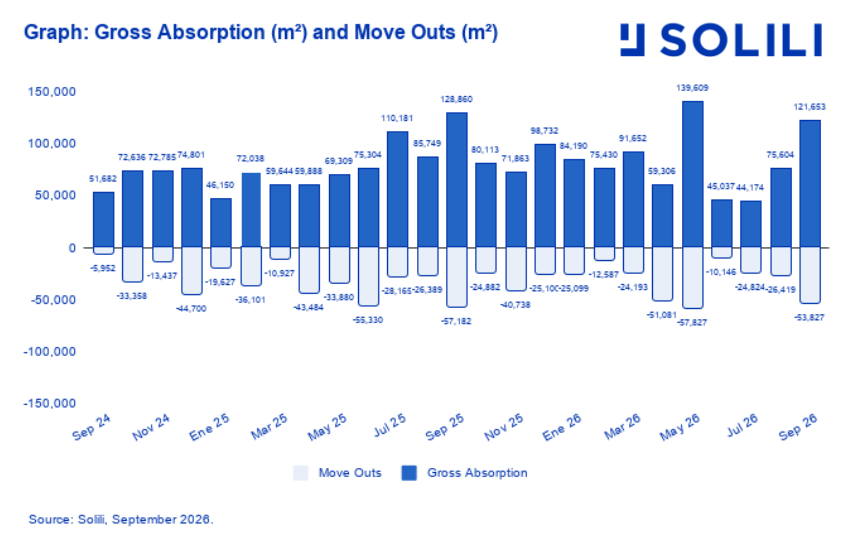
On the demand side, national gross absorption continues to show solid activity. In September 2026, 615,400 square meters were occupied, 5% more than in September 2025 and 11% above September 2024.
From January through September 2026, gross absorption reached 4.0 million square meters, 8% above the same period in 2025. Given this performance, gross absorption is expected to close 2026 above the levels recorded in 2025.

As 2026 draws to a close, industrial demand maintains a favorable outlook, primarily supported by logistics and warehousing activity, as well as the expansion of established companies. While some manufacturers have postponed investment and expansion decisions amid the current trade environment, strengthening supply chains and companies’ space requirements continue to support leasing activity and could contribute to stronger momentum toward year-end. Overall, the industrial market maintains a positive outlook, with conditions potentially improving as companies finalize their operating and investment plans for 2027.
Stay up to date with the most important news to the real estate
Subscribe Solili Newsletter