Mexico’s industrial real estate market continues to adapt to the new conditions of the global economic landscape. Throughout 2026, the industrial real estate sector has seen its growth pace moderate amidst a climate of heightened caution among companies and investors.
Globally, the industrial sector is undergoing a period of adjustment in an environment defined by geopolitical tensions, shifting international trade patterns, and uncertainty regarding long-term investments. The conflict between the United States and Iran and the closure of the Strait of Hormuz have once again brought strategic trade routes and energy and transport costs into the spotlight, driving up logistics and operating expenses for companies and influencing their expansion plans.
In Mexico, this situation coincides with the renegotiation of the USMCA—a critical process for the industrial sector given its role in trade flows and supply chains linking Mexico, the United States, and Canada. The progression of these negotiations, combined with broader global uncertainty, has prompted companies to adjust or postpone projects, thereby tempering manufacturing demand and, consequently, the need for industrial space.
By the end of the third quarter of 2026, national industrial inventory stood at 115.1 million square meters, representing a year-over-year increase of 5.5 million square meters. In September, vacant space totaled 6.3 million square meters, corresponding to a national vacancy rate of 5.5%.

From a historical perspective, the vacancy rate declined between 2022 and 2023, reflecting the robust industrial demand seen during the nearshoring boom. Starting in 2024, this trend reversed, and vacant space began to rise steadily amidst heightened global trade tensions that impacted industrial investment and the demand for new space. Consequently, the national vacancy rate surged threefold, climbing from a historic low of 1.8% in mid-2023 to 5.5% by the third quarter of 2026.
The rise in vacancy was particularly pronounced in manufacturing-oriented markets along Mexico's northern border. Relative to their 2023 lows, Tijuana saw the largest increase—900 basis points—ending the third quarter of 2026 with a vacancy rate of 10.2%. Markets such as Reynosa, Monterrey, and Ciudad Juárez experienced increases of around 600 basis points, reaching rates of 7.3%, 7.0%, and 6.0%, respectively—figures that rank among the highest vacancy levels nationwide. In contrast, the lowest rates were found in Aguascalientes (0.9%), Puebla (2.1%), and Saltillo (2.3%).
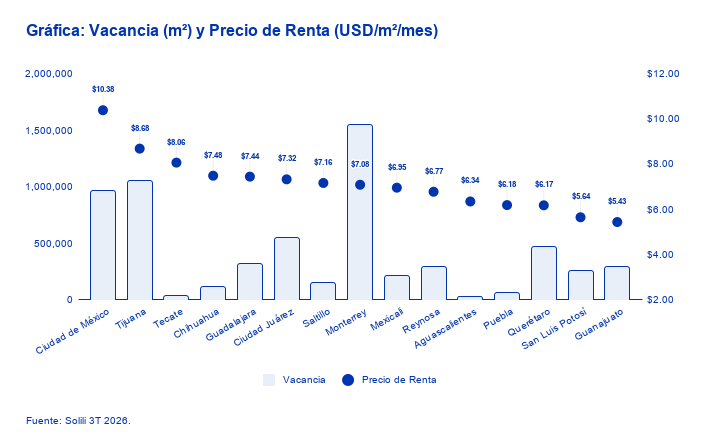
Mexico City, Monterrey, and Tijuana recorded the largest year-over-year increases in vacant space, with rises of 595,000, 390,000, and 255,000 square meters, respectively. Conversely, Mexicali, Chihuahua, and Aguascalientes were the only markets to report a decline in vacant industrial space, with annual reductions of 50,000, 35,000, and 12,000 square meters, respectively. Average industrial asking rents remained largely unchanged, with most markets closing at stable rates very similar to those reported since late 2025. Developers are keeping prices steady in an effort to make their spaces competitive amidst a landscape of high vacancy levels.
Monterrey stands out for having maintained stable prices over the past two years. Similarly, markets such as Tijuana, Ciudad Juárez, and Reynosa have seen no significant changes in rental rates. In contrast, some markets—such as Mexico City and Saltillo—continue to show year-over-year increases.

The national average asking price for industrial space stood at $7.67 per square meter per month at the close of the third quarter of 2026. Mexico City recorded the highest level at $10.38, followed by Tijuana at $8.68 and Tecate at $8.06; these were the only markets exceeding the national average. Guanajuato, San Luis Potosí, and Querétaro—all part of the Mexican Bajío region—ended the quarter with the most competitive prices, a trend observed over the past three years.
In major national industrial markets like Mexico City, last-mile logistics operations—concentrated in the Vallejo submarket—secured contracts at rates close to $12.00 per square meter per month. Meanwhile, in the CTT zone (comprising the Cuautitlán, Tultitlán, and Tepotzotlán submarkets), contracts were finalized at rates ranging from $9.50 to $13.50 per square meter per month. Average asking prices in the Mexico City market are lower than the rates at which contracts are actually being signed, particularly in traditional submarkets like those mentioned above; property location and construction characteristics are the most significant factors when choosing to rent space in the capital's market. In Monterrey, the Apodaca industrial submarket saw contracts finalized at rates hovering around $7.50 per square meter per month. In Tijuana, closing prices showed greater variance—ranging from approximately $5.40 to $9.90 per square meter per month—depending on space characteristics, class, location, and size. Nationwide—and particularly in markets with high vacancy rates—asking prices remain stable, although the gap between asking and closing prices is wider than in previous years. Amid the rise in vacant space, leasing expectations for new developments are now more aligned with current market conditions, without this resulting in a reduction in asking prices.
During the third quarter of 2026, industrial deliveries in Mexico totaled 1.4 million square meters. The volume of completions still reflects construction activity accumulated over previous years, as those projects have reached completion and been added to the inventory. In Q3 2026, Monterrey accounted for 33% of the new supply, followed by Mexico City and Guadalajara, with shares of 23% and 17%, respectively.

However, figures for deliveries are beginning to decline. Between January and September 2026, completed space totaled 3.5 million square meters—30% less than the 5 million recorded during the same period in 2025. This trend points to a lower volume of space coming onto the market toward the end of the year, consistent with the reduction in total space under construction and fewer new project starts.
Meanwhile, construction starts reached 790,000 square meters during the third quarter of 2026. The decrease in new construction activity reflects greater selectivity in development, particularly in markets with higher vacancy rates. In this context, Mexico City and Tijuana saw the sharpest drops in construction starts compared to the same period in 2025—falling by 38% and 87%, respectively—whereas Guadalajara saw the volume of new construction starts triple, and Monterrey recorded 22% year-over-year growth.
Between January and September 2026, construction starts totaled 2.5 million square meters, 35% below the figure recorded during the same period in 2025. This reduced activity is particularly beneficial for markets with high vacancy rates, as it limits the addition of new space.
Total construction activity in the country declined after hitting an all-time high in late 2024, when the volume of space under development exceeded 5.9 million square meters. Since that peak, activity has seen two consecutive annual declines, standing at 3.4 million square meters at the close of the third quarter of 2026. This trend also reflects the postponement or pausing of certain projects due to current market conditions, especially in markets with a high supply of available space.

The reduction has been particularly pronounced in five markets that reached their peak levels of space under construction in late 2023. Monterrey recorded a 63% decrease since then; with 759,901 square meters under construction as of the third quarter of 2026, it ranks second nationwide, trailing only Mexico City, which hovers around one million square meters. In Ciudad Juárez, Querétaro, Saltillo, and Tijuana, the space under construction fell by 86%, 76%, 74%, and 58%, respectively, compared to their peaks during that period.
During the third quarter of 2026, industrial space vacancy in Mexico totaled over 560,000 square meters. Mexico City accounted for 27% of the national total, followed by Reynosa (15%) and Querétaro (10%); together, these three markets represented just over half of the space vacated during the quarter. In contrast, Guanajuato recorded a 2% share, while Aguascalientes and Puebla accounted for 1% each. Chihuahua and Tecate recorded no vacated space during the third quarter of the year.
Mexico City is the national market with the largest amount of space vacated during the quarter; however, this does not signal pressure on market indicators. Although vacancy has risen compared to the previous year, demand remains higher than the amount of vacated space, allowing for healthy vacancy rates, stable rental prices, increased construction activity, and an optimistic market outlook.

Uncertainty regarding the international economic and political landscape has primarily impacted demand from manufacturing companies, whose activity has lost momentum compared to levels seen in previous years. Companies have postponed investment and expansion decisions while assessing the impact of shifting trade relations, operating costs, and supply chain dynamics in Mexico.
Compounding this scenario is the increasingly significant role of logistics operations within the industrial market. Companies are seeking to strengthen supply chains and optimize operations amidst rising transport and fuel costs. A potential closure of the Strait of Hormuz could drive these costs higher, while the growing presence of Chinese companies in North American supply chains introduces new variables to the commercial environment. Consequently, logistics activity has emerged as a key driver of demand for industrial space in Mexico.
Industrial demand in Mexico remained robust and stable throughout 2026. Gross absorption reached 1.6 million square meters in the third quarter, a 5% increase over the same period in 2025. Cumulative gross absorption for the January–September 2026 period totaled 4 million square meters—8% higher than the previous year—suggesting that year-end figures will surpass those recorded in 2025.
During the third quarter, Mexico City was the most active leasing market, accounting for 28% of total national gross absorption, while Monterrey and Guadalajara each recorded a 14% share. The demand mix showed a greater emphasis on logistics and warehousing activities, particularly in major urban centers, where e-commerce and retail companies continue to drive the need for space. Querétaro and Tijuana stood out for reporting a high volume of transactions, though these were dominated by the occupancy of smaller spaces—averaging around 6,000 square meters—contrasting sharply with the Mexico City market, where the average transaction hovered around 20,000 square meters.
Monterrey and Guadalajara accounted for some of the quarter's largest transactions, specifically those linked to manufacturing operations. In Monterrey, a notable deal involved LEGO, which absorbed nearly 50,000 square meters in the Ciénega de Flores submarket, while in Guadalajara, Foxconn occupied two spaces totaling 87,000 square meters in El Salto.
The expansion of companies already established in Mexico remains a key driver of demand, primarily to meet logistics and warehousing needs. In manufacturing-oriented markets, these expansions also address the logistical requirements of production chains themselves, whereas leases dedicated directly to manufacturing are more specific in nature and generally stem from long-term investments.

Net absorption totaled 1.3 million square meters during the third quarter of 2026. The country's major markets recorded positive net absorption; Monterrey accounted for 28% of the total, followed by Mexico City and Guadalajara with 21% each. Reynosa was the only market nationwide to report negative net absorption.
For the period from January to September 2026, net absorption totaled 2.9 million square meters—15% lower than the 3.4 million recorded during the same period the previous year. However, net absorption showed consecutive increases throughout 2026, and in the third quarter, it surpassed the level recorded during the same period of 2025.
At the close of the third quarter of 2026, major markets maintain a dynamic that, while less rapid than in previous years, continues to sustain the country's industrial development. Mexico City maintains solid performance, with demand supporting the market, while Monterrey—despite lower activity compared to its industrial boom between 2022 and 2024—remains above pre-pandemic levels. Guadalajara continues to grow, driven by strengthened logistics operations, whereas Tijuana and Reynosa face more challenging scenarios; lower leasing levels and increases in unleased and vacant space—nearing oversupply levels—highlight the challenges these markets face in the current context.
Looking toward the fourth quarter of 2026, the renegotiation of the USMCA and the U.S. midterm elections will be key factors for industrial activity. The election outcome could bring greater clarity to U.S. trade policy and foster an environment of increased certainty for Mexican manufacturing. Added to this is the potential reopening of the Strait of Hormuz, which would help reduce transportation and fuel costs.
At Solili, we project increased momentum as the year draws to a close. The fourth quarter typically sees a concentration of occupancy and expansion decisions by companies aiming to have their operations ready by the start of the new year, a trend that could boost activity in the industrial market. Consequently, we anticipate a more active end to 2026, with markets—particularly those along the northern border, such as Tijuana, Reynosa, and Ciudad Juárez—poised for recovery.
Stay up to date with the most important news to the real estate
Subscribe Solili Newsletter