Mexico’s office real estate market continues to adapt to an economic environment characterized by greater caution regarding corporate investment and expansion decisions. Throughout 2026, financial conditions and the cost of capital have constrained some corporate activity. In September, the Bank of Mexico held its interest rate at 6.5%, while the U.S. Federal Reserve raised its rate from 3.5% to 4%—amidst ongoing restrictive monetary policies—and the peso traded above 18 units per dollar. Compounding this scenario are tensions in the Middle East and rising fuel costs, which continue to pressure corporate operating expenses and limit expansion capacity. In the corporate market, this dynamic is reflected in more selective demand, with a preference for high-quality office spaces that offer the flexibility to adjust floor area according to operational needs.
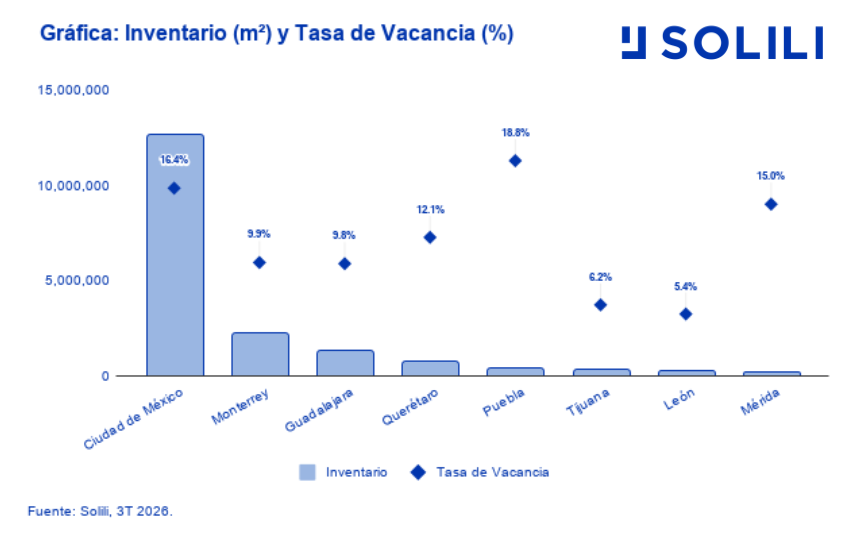
By the end of the third quarter of 2026, the national office market stock exceeded 18 million square meters, with 12.6 million concentrated in Mexico City. Stock growth remains moderate compared to the dynamism seen prior to the pandemic, when annual growth exceeded 6%. Since then, the pace has steadily declined, reaching just 1.6% during 2025. At the close of the third quarter of 2026, the stock showed an increase of 390,000 square meters compared to the same period the previous year, representing a year-over-year growth rate of 2.2%.
Although stock expansion has slowed across the board since the pandemic, Monterrey and Guadalajara continue to record increases. Markets where the development of new spaces has shifted toward more sophisticated products featuring higher standards of construction and amenities, as well as sustainability and technology elements—such as certifications, high-capacity and high-speed elevators, and smart parking systems. This evolution responds to increasingly demanding corporate requirements for spaces that offer superior quality, efficiency, and adaptability to their needs.

Vacant space across the eight major corporate markets totaled 2.6 million square meters, concentrated primarily in the country's three main corporate hubs: Mexico City, with 2.1 million square meters; Monterrey, with 221,000; and Guadalajara, with 128,000.
Compared to the third quarter of the previous year, vacancy decreased in six of the eight markets analyzed. Mexico City recorded the largest reduction, with 126,000 fewer square meters, followed by Monterrey (42,000), Puebla (14,000), Querétaro (9,000), and León and Tijuana (3,000 square meters each). In contrast, Guadalajara and Mérida saw their available space increase by 8,000 and 6,000 square meters, respectively.
In the third quarter of 2026, the composition of vacancy by building class showed varying trends across the three major office markets. In Mexico City, Class B vacancy fell by 15% year-over-year, compared to 2% for Class A, suggesting greater tenant interest in factors such as price and location. Conversely, Monterrey recorded a 22% drop in Class A vacancy, while Class B vacancy rose by 3%, indicating higher absorption of more sophisticated, modern, and efficient spaces. Guadalajara saw increases in both categories, though more sharply in Class B, where vacancy rose 30% year-over-year compared to 3% for Class A.
The highest office vacancy rates for the quarter were found in Puebla and Mérida, at 18.8% and 15.0%, respectively. In contrast, Tijuana recorded a rate of 6.2%, while León posted the lowest level nationwide, at 5.4%. In Tijuana, vertical growth has focused primarily on residential and mixed-use projects—with a significant presence of medical services—while the financial, technology, and business services sectors maintain high occupancy levels in office spaces. Meanwhile, in León, industrial and service-sector activity, alongside the development of sectors such as technology and logistics, has also driven high occupancy levels in the corporate market.

The national average office asking price stood at $20.53 USD/m²/month in Q3 2026, a 2.0% increase compared to the same period the previous year. This price stability occurs in a market where companies continue to prioritize spaces that meet their operational needs—considering factors such as location, functionality, infrastructure, and contractual terms, alongside rental rates. Consequently, a property's specific features and benefits can justify higher rents when they align with tenant requirements.
Mexico City maintains the highest rental rates among the country's major office markets, although variations across submarkets differ—a pattern also observed in Monterrey and Guadalajara. An analysis of the central business districts in each market reveals significant price variations.
In Mexico City’s Reforma submarket, the average rate reached $24.01 USD/m²/month, with Class A and Class B properties recording $29.36 and $18.23 USD/m²/month, respectively. Polanco reported an average rent of $23.73 USD/m²/month; Class A space averaged $25.94 USD/m²/month, compared to $20.37 USD/m²/month for Class B.
In Monterrey, Valle Oriente posts the highest rental rates, averaging $20.34 USD/m²/month, with Class A space reaching $21.52 USD/m²/month and Class B space at $16.35 USD/m²/month. Meanwhile, Santa María recorded an average of $18.29 USD/m²/month, with $18.75 USD/m²/month for Class A and $14.39 USD/m²/month for Class B.
In the Guadalajara market, Puerta de Hierro recorded rental rates of $21.67 USD/m²/month—$21.84 USD/m²/month for Class A and $20.27 USD/m²/month for Class B—while the New Financial Zone reached $20.77 USD/m²/month, with rents of $22.40 and $18.66 USD/m²/month for Class A and Class B, respectively.
Office construction continues at a moderate pace, reflecting the caution that has prevailed among developers since the pandemic. Although key market indicators show improvement compared to the post-health-crisis period, the decision to launch new projects remains conservative. As of the third quarter of 2026, nearly 1 million square meters were under construction nationwide, concentrated primarily in Mexico City, Monterrey, and León, with shares of 40%, 16%, and 10%, respectively. This stance is particularly understandable in Mexico City, where, despite a sustained reduction in vacancy, 2.1 million square meters of space remain available—varying in size, location, rental rates, building specifications, and amenities—thereby maintaining a large supply with which new projects must compete.

However, the country's major corporate markets have moved past the oversupply conditions that characterized previous years, while current supply and demand levels are once again beginning to justify the development of new space. Reduced vacancy and price stability are creating more favorable conditions for construction, although available space remains a factor requiring caution among developers. During the third quarter of 2026, Mérida and Guadalajara saw the start of projects totaling 2,200 and 700 square meters, respectively, while Guadalajara and León completed projects totaling 3,500 and 600 square meters.
During the third quarter of 2026, national move outs totaled 105,000 square meters. Mexico City accounted for 79% of the total, followed by Monterrey with 7% and Guadalajara with 5%. The remaining markets recorded moderate vacated space levels.
In Mexico City, vacated space showed a year-over-year decrease of 19%, reflecting a favorable trend in occupancy conditions within the country's primary office market. Move outs were concentrated mainly in the Polanco, Norte, and Insurgentes submarkets, with 17,000, 15,000, and 13,000 square meters, respectively. Class A spaces accounted for 77% of the vacated area, while Class B spaces represented the remaining 23%.
In Monterrey, move outs were concentrated primarily in the Valle Oriente submarket (3,300 square meters) and the Ricardo Margain-Gómez Morin submarket (2,600 square meters). Meanwhile, Guadalajara saw the bulk of its vacancies in the Vallarta-Américas submarket, with 3,000 square meters. In both markets, Class A spaces accounted for the largest share of vacated space, representing 67% in Monterrey and 62% in Guadalajara. In the country's major cities, the market offering is also shifting toward coworking and coliving formats, accompanied by greater integration of services, amenities, and mixed-use elements. These models cater to a demand for greater flexibility in space utilization and new alternatives for combining work activities and services within a single development. This trend drives increased sophistication in corporate projects and expands the options available to users.

During the third quarter of 2026, national gross absorption reached 241,000 square meters, a 25% decrease compared to the same period in 2025. However, the cumulative figure from January to September exceeded 737,000 square meters—5% higher than the volume recorded during the same period the previous year—keeping demand levels above those observed in 2025.
An analysis of historical trends reveals a sustained recovery in gross absorption following the contraction experienced during the pandemic. After peaking at 980,000 square meters in 2019, demand fell by nearly half during 2020 and 2021. Starting in 2022, the market regained momentum, once again surpassing the one-million-square-meter mark in 2023 and maintaining levels comparable to the pre-pandemic era ever since. Cumulative leasing activity from January to September 2026 has already surpassed the demand recorded during the same period the previous year; consequently, if the current pace continues, total occupancy will exceed the levels seen in 2025.
Quarterly demand was concentrated primarily in the country's three major corporate hubs. Mexico City accounted for 64% of national gross absorption, followed by Guadalajara with 15% and Monterrey with 10%. By space type, the majority of transactions involved Class A offices. In Mexico City, Monterrey, and Guadalajara, the leasing of premium space represented 80%, 85%, and 61% of transactions, respectively. Demand in these markets continues to be driven by large domestic companies and international tenants who prioritize established locations, robust infrastructure, and conditions suited to their operational needs. Gross absorption in the third quarter stood 15% above levels recorded prior to the health crisis. While Mexico City maintains absorption levels similar to those observed before the health crisis, Monterrey and Guadalajara have surpassed the activity levels recorded during that period.
Prior to the pandemic, national vacancy rates were higher, and office construction maintained a very solid, stable pace, with large-scale projects frequently breaking ground. Currently, although demand is recovering and vacancy rates are trending downward, the development of new projects remains subdued. Investor caution reflects greater selectivity regarding new developments, even amidst the market recovery.
Office demand has undergone a transformation in recent years. While coworking operators have maintained steady activity, it is now less common for these companies to lease entire floors or large blocks of space within buildings. Flexible workspace providers compete directly with developers for the same tenants—sometimes within the very same building—altering how corporate spaces are marketed and occupied.
In the capital, the primary submarkets driving demand were Polanco and Norte, accounting for 32% and 24% of market absorption, respectively. Notable large-scale leases included spaces at Mariano Escobedo 573, Forum Naucalpan, and Corporativo Diagonal. In Monterrey, the key submarkets for office occupancy were Centro and Valle Oriente, representing 35% and 27% of quarterly absorption, with significant activity at PuntAcero, Torre 411, El Gran Ancira, and Torres Obispado. In Guadalajara, the most sought-after corporate zones were Nueva Zona Financiera and Puerta de Hierro, accounting for 29% and 22% of absorption. Dos Puntas Corporate Tower, Torre Panorama Zapopan, and Midtown Jalisco recorded some of the largest lease transactions by area.
 Following the close of the third quarter of 2026, major office markets continue to show a trend toward greater stability. The Mexico City office market maintains solid performance and has recovered, with demand continuing to exert downward pressure on availability. Monterrey continues to evolve favorably, with increased absorption of Class A space and leasing activity exceeding pre-pandemic levels. Meanwhile, Guadalajara is recording rising demand, although available space also increased over the past year. The León (Guanajuato) and Tijuana markets remain stable with low vacancy levels, while Querétaro continues to see a reduction in available supply. In contrast, Puebla and Mérida face greater challenges due to a slower recovery and vacancy rates above the national average.
Following the conclusion of the third quarter of 2026, the office market maintains a dynamic of greater stability, albeit within a climate of caution. Demand trends during the final quarter of the year will be shaped by external factors—such as ongoing warfare, geopolitical conflicts, and international financial conditions—as well as internal factors related to macroeconomic stability, exchange rates, financing conditions, and the political environment.
Progress on infrastructure projects and activity in sectors such as manufacturing, logistics, and services will also play a key role in driving demand across the various markets. Under these conditions, companies will remain selective in their occupancy decisions, while declining vacancy rates and price stability continue to foster conditions for a gradual market recovery.
Stay up to date with the most important news to the real estate
Subscribe Solili Newsletter